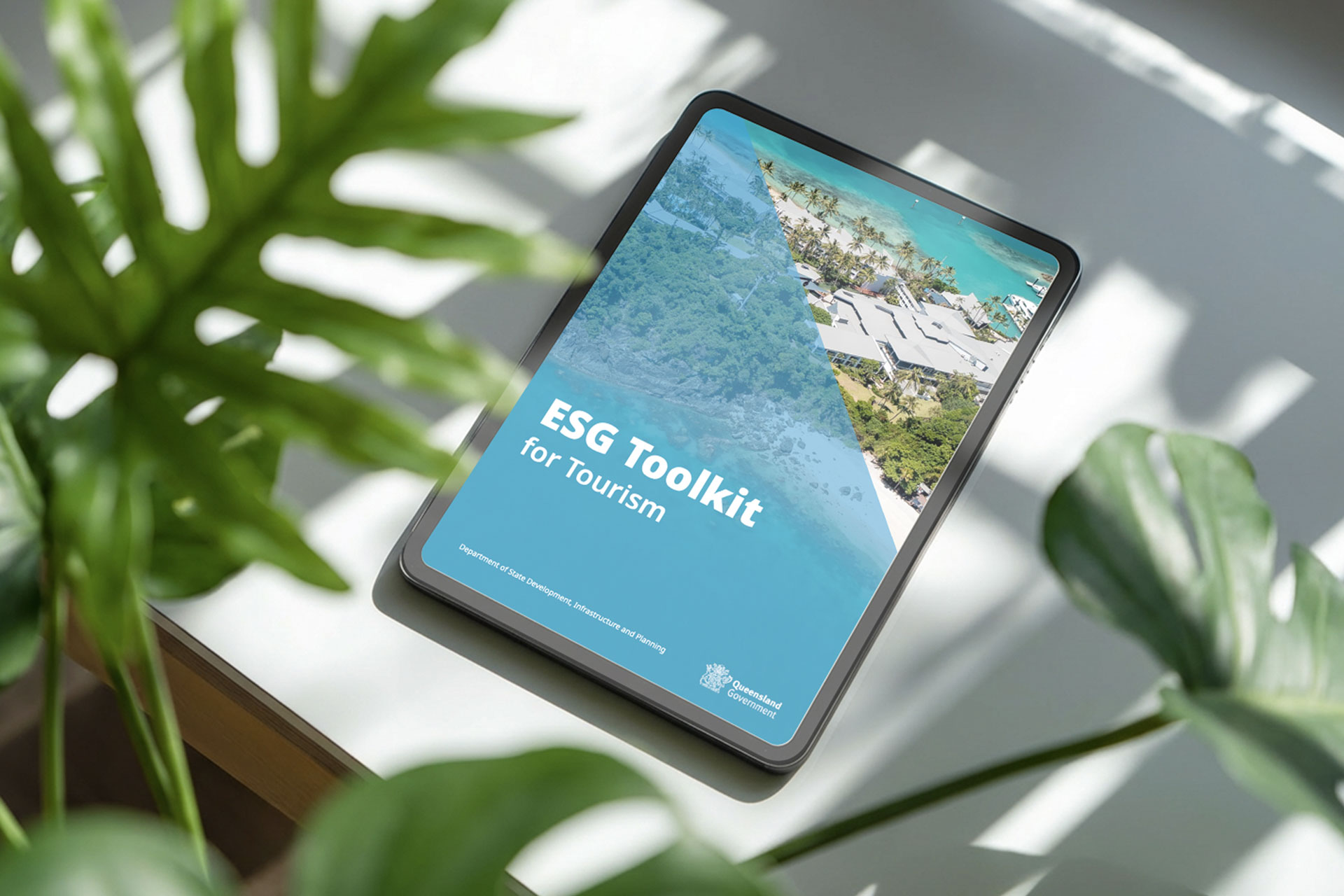

Developed for the Department of State Development, Infrastructure and Planning, the toolkit responds directly to the growing pressure on tourism businesses to provide clear, credible ESG information, particularly as larger organisations begin to assess the performance of their supply chains.
The result is a practical, step-by-step resource tailored specifically to the needs of small and medium-sized tourism operators, providing a structured pathway from early understanding through to formalised ESG reporting.
A practical starting point
For many tourism businesses, ESG can feel complex or difficult to operationalise. The toolkit breaks this down into a structured, step-by-step process, guiding businesses through how to:
- Define their ESG ambition and align it with their business goals and value
- Establish internal ownership and engage their team
- Assess risks and identify what is most material to their operation
- Gather baseline data to understand current performance
- Set measurable goals and timeframes
- Design and implement a clear ESG strategy
- Monitor progress and formalise reporting over time
The toolkit is built as a staged pathway. It introduces three levels of action – Foundation, Advanced and Expert – allowing businesses to start with the basics and progressively build more formal systems, processes and reporting as their capability grows.
This approach is supported by practical checklists, case studies and guidance across environmental, social and governance priorities, helping operators translate high-level concepts into actions that make sense for their size, resources and operating environment.
The toolkit also recognises the realities of smaller businesses, including limited time, internal expertise and influence across supply chains. It provides guidance on how to work within those constraints, from partnering with local suppliers and tourism networks to building internal capability through simple governance structures and clear accountability.
Rather than requiring a fully developed sustainability program from day one, the framework is designed to meet businesses where they are, whether they’re just starting out or looking to formalise existing initiatives.
Over time, it supports a progression from informal action to more structured measurement, strategy and reporting.
Dr Natasha Montesalvo, Principal Consultant – Destinations, Strategy & Insights, says the toolkit was developed to help smaller operators turn existing good practice into a more structured and strategic ESG approach.
“We know many tourism operators are already taking positive action, but they may not always have the language, structure or systems to frame that work through an ESG lens,” Dr Montesalvo says.
“The toolkit is designed to make that process more accessible, helping businesses understand what matters, where to focus, and how to build from there.”
Why ESG expectations are reaching smaller operators
The release of the toolkit comes at a time when ESG requirements are increasingly flowing through supply chains.
As outlined in EarthCheck and K&L Gates’ recent briefing paper on Australia’s climate-related financial disclosure regime, larger organisations are now required to report on emissions and risks across their value chains, including the businesses they work with.
This means SMEs are increasingly likely to be asked for information about how they operate, even if they’re not required to produce formal ESG disclosures themselves. That could include requests from corporate clients, travel buyers, booking or distribution partners, investors, suppliers or other commercial stakeholders.
In some cases, businesses that can’t provide satisfactory ESG-related information may be asked to complete corrective action plans, or risk disrupting commercial relationships until that information can be supplied.
That’s why the toolkit places a strong focus on helping operators understand what information they may be asked to provide, and how to begin capturing and presenting it in a way that’s structured, credible and useful.
This can include:
- A sustainability policy or supplier code of conduct
- Evidence of how environmental impacts are being reduced
- Emissions-related information from business operations including energy use
- Labour, diversity, health and safety policies
- Sourcing and procurement practices
- Anti-corruption, ethics and governance controls
Stewart Moore, Founder and CEO of EarthCheck, notes that the toolkit is both a practical resource and a timely response to the changing expectations facing tourism operators.
“There’s a growing expectation for tourism businesses to be able to back up what they say with clear action and credible information,” he says.
“This toolkit helps operators get started, and EarthCheck can help businesses build on that foundation as expectations continue to evolve.”
How EarthCheck can support your ESG journey
Dr Steve Newman, Chief Sustainability Officer at EarthCheck, says the ESG Toolkit for Tourism was designed to provide practical support for businesses at different stages of their sustainability journey.
“The toolkit is designed to help organisations better understand ESG in the context of their own operations, identify what matters most, and take action in a way that is realistic and relevant to their business,” Dr Newman says.
“For some, it will help formalise work already underway. For others, it can support deeper thinking around areas like measurement, governance, strategy and reporting as their ESG approach continues to evolve.”
For more than 30 years, EarthCheck has worked with governments, businesses and destinations to deliver science-backed, strategic and sustainable outcomes. Its rigorous benchmarking and certification programs are recognised globally, helping organisations understand their performance and giving travellers confidence in the experiences they choose.
Building on this foundation, EarthCheck’s ESG services are designed to help organisations understand where they are now, identify what matters most, and embed sustainability across every level of their operations. This includes support with:
- Measuring Scope 1, 2 and 3 emissions
- Conducting climate risk analysis
- Developing decarbonisation strategies
- Identifying and prioritising material ESG risks
- Building ESG strategies and roadmaps
EarthCheck also works with organisations to translate ESG performance into clear, transparent and impact-oriented reporting, aligned with globally recognised frameworks such as GRI, ISSB and ESRS, as well as emerging regulatory requirements.
Beyond compliance, this work supports stronger business outcomes, helping organisations manage long-term risk, strengthen brand positioning, build trust with stakeholders and access new opportunities for investment and growth.
Access the toolkit
The ESG Toolkit for Small Tourism Businesses is now available to download, providing a practical starting point for operators looking to better understand, manage and communicate their ESG performance.
For organisations ready to take the next step, EarthCheck’s ESG advisory services can provide tailored support to help build capability, strengthen reporting, and embed ESG into day-to-day operations and long-term planning.
Talk to the EarthCheck team today.