
Image courtesy of Tourism & Events Queensland
The challenge is that events also carry a heavy footprint. The average conference attendee generates ~1.89 kg of waste per day, meaning a four-day, 600-delegate conference can produce almost five tonnes of waste from attendees alone. Multiply that across hundreds of gatherings each year, and the scale of the problem becomes impossible to ignore.
The opportunity is that the very practices that cut this footprint are also the ones that deliver stronger business outcomes. Sustainable event strategies are proving to be drivers of efficiency, resilience and competitive edge. They reduce costs and waste, strengthen trust with clients and communities, and equip teams with the skills to deliver better outcomes, year after year.
As Melissa Hamilton, Principal Consultant – Sustainable Meetings & Events at EarthCheck, explains: “Five to ten years ago, people were only beginning to discuss sustainability in relation to events. Now, it’s no longer about whether events should be sustainable. The conversation has moved to action. Clients, attendees and regulators expect it, and they expect organisers to be able to prove it.”
The case for sustainable events isn’t one of obligation, but of opportunity and responsibility. Done well, they deliver value across four dimensions: cost efficiency, brand and reputation, compliance and credibility, and long-term capability. Responding to social change within the communities they operate in is also a core responsibility for events and a chance to leave a positive legacy.
Together, they make sustainability a lever for sharper, smarter and more successful events.
Lean, green and cost-effective
A persistent myth is that sustainability comes at a premium. In practice, sustainable event strategies often prove more economical, delivering both immediate savings and avoided penalties – a win for budgets and for corporate sustainability goals.
Food waste is one of the biggest culprits. According to End Food Waste Australia, up to 30% of catered food goes uneaten at Australian events, contributing to the 1.2 million tonnes of food wasted annually by the hospitality sector (which makes up 16% of Australia’s total).
The Sydney Royal Easter Show has reported food waste as one of its largest categories, tackling it with composting and food rescue programs. In the corporate world, it’s the overestimated sandwich platter or buffet that ends up in the bin, representing wasted spend as much as wasted food.
The fix lies in catering smarter, and in shifting expectations. More accurate RSVPs, right-sized portions, and grab-and-go healthy options reduce over-ordering, cut costs, and keep food out of landfill. It also requires a change in mindset from guests: taking the time to RSVP honestly, and recognising that a buffet that looks a little less abundant has actually been designed to reflect what people will realistically eat.
Hamilton describes it as a paradigm shift: “True sustainability doesn’t mean less experience. It means less excess.”
Beyond portion control, sourcing also plays a role. Hamilton notes that choosing seasonal and local produce “can deliver huge cost savings, not to mention better quality.” Menus built around what’s in season avoid inflated prices for imported ingredients, cut food miles, deliver fresher options and help build stronger local communities. Plant-based dishes tend to be cheaper too, lower in carbon, and more in line with modern dietary expectations.
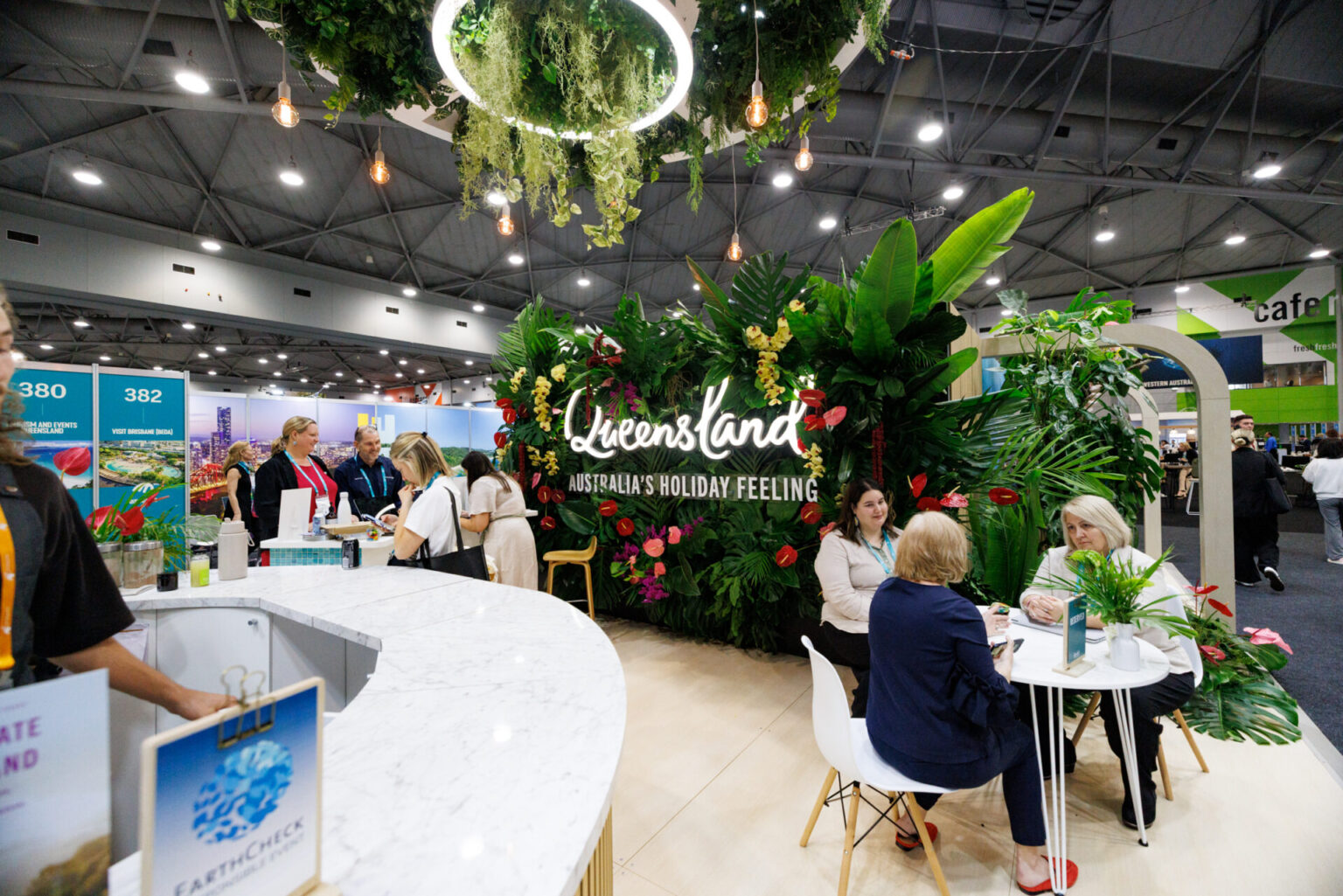
Waste management is another area where investment pays off. At the 2025 Australian Tourism Exchange’s Queensland Showcase, an outdoor event for over 1,100 delegates, organisers spent $3,850 on labour and infrastructure to support five separate waste streams. This ensured waste was diverted from landfill and met Tourism and Events Queensland’s sustainable event commitments. Without this, they would have faced $2,788 in extra waste costs and up to $4,300 in clean-up fees. What seemed like an added expense became a cost-neutral, even cost-saving, approach.
The same principle applies to production and logistics. Oversized generators, for example, can waste 30-50% of fuel at low loads. By right-sizing units or combining them with hybrid battery systems, organisers can reduce consumption and cut fuel bills by as much as 40%. Add in well-managed fuel storage and planning, and costly emergency deliveries or contamination risks can be avoided.
The common thread is measurement. Tools like the EventCalculator allow organisers to track energy, waste, catering and travel impacts with precision. As Hamilton puts it: “Accurate data is always the best way to find areas for reduction and to track success. Estimates are great in the planning process, but if you want tangible success you need to measure, make changes, then measure again.”
With this data, procurement choices and operational plans can be tied directly to financial outcomes. That means predictable budgets and clear evidence that sustainability is not just an ethical decision, but an economic one.

Image courtesy of Tourism & Events Queensland
The visible signs of a sustainable event
These visible choices signal a greener meeting in practice, where impact reduction is intentional and measurable.
| Traditional practice | Sustainable alternative | Impact |
| Plastic lanyards and badges | Plantable seed paper, durable fabric, or reusable multi-day name tags | Cuts single-use plastics; creates lasting value |
| Printed programs and signage | Event apps, QR codes and digital displays | Saves printing costs; reduces paper waste |
| Disposable cups, bottles and cutlery | Reusable service ware and on-site water refill stations | Lowers ongoing costs; diverts waste from landfill |
| Out-of-season or imported catering | Seasonal, locally sourced and more plant-based menu options | Cuts food miles; reduces spend; meets dietary expectations |
| General waste bins only | Multi-stream waste separation (e.g. recycling, compost, landfill) | Increases recovery rates; avoids venue clean-up penalties |
| Over-catered buffets | Accurate RSVPs, right-sized portions, grab-and-go healthy options | Reduces food waste; lowers catering spend |
| Unverified sustainability claims | Independent verifications for sustainability frameworks (e.g. ISO 20121) | Builds credibility; reduces risk of greenwashing |
Protecting reputation and brand value
Reputation is one of the most valuable assets an event can influence. Delegates notice when organisers go beyond token gestures and weave sustainability into every detail. These choices signal intentionality, position the brand as forward-looking and responding to community concerns.
As Hamilton explains: “If you can see the organiser has considered the impact of every element, from the lanyard to the catering to the waste streams, then you know sustainability has been built into the process, not just bolted on at the end.”
Engaging attendees in this shift deepens their connection with the event and reinforces its purpose.
Merchandise waste illustrates this point. Research by the Advertising Speciality Institute found that almost one quarter of promotional items are thrown away, with only 21% kept long term. For organisers, this underscores the need to rethink swag strategies: fewer disposable items, more meaningful, lasting takeaways.
Sustainability is increasingly tied to consumer behaviour. According to the Harvard Business Review, 65% of consumers are more likely to buy from companies they perceive as environmentally responsible. Events benefit from the same halo effect – when organisers demonstrate responsibility, they build trust and affinity with delegates.
Transparency further strengthens that reputation. Organisations that communicate openly about what worked, where challenges arose, and what they plan to improve upon build goodwill and credibility.
Independent recognition magnifies the impact. Verified systems, such as EarthCheck’s Sustainable Event Management (SEMS) framework, give organisers the confidence to make credible claims while showing stakeholders their commitments are genuine and internationally benchmarked.
This goes beyond optics; it’s a simple commercial reality. Procurement teams increasingly weight sustainability in RFPs and tenders, and verified performance is often a scored criterion. In close contests, evidence-backed delivery can be the tie-breaker that wins the work.
Compliance and credible reporting
If reputation is about how stakeholders perceive your commitments, compliance is about proving those commitments under scrutiny. Around the world, regulators are tightening expectations on environmental reporting, and events are firmly within scope.
Climate-related financial disclosure regimes are expanding, requiring companies to quantify not only their direct (Scope 1 and 2) emissions, but also relevant Scope 3 categories such as travel, procurement and waste. These are the very areas where event impacts show up most clearly: delegate flights, hotel nights, catering, logistics and materials. In Australia, mandatory disclosures have already begun for large entities.
In Europe, the Green Claims Directive will require companies to substantiate voluntary environmental claims with scientific evidence and independent verification. For organisers, this means that broad statements like “carbon neutral event” or “eco-friendly conference” must be backed by data, or risk being deemed misleading.
Together, these measures signal a regulatory climate converging on one principle: environmental claims must be specific, measurable, defensible, and supported by science. For event organisers, the challenge is how to provide that proof in a way regulators, investors and clients will accept.
“Second-party systems and verifications reduce the risk of greenwashing,” Hamilton says, “and give organisers the confidence to make credible claims.”
Aligning with recognised frameworks, such as ISO 20121, provides the structure needed – embedding reliable measurement, documented processes and verification that welcome scrutiny. In practice, this transforms events from potential compliance risks into defensible case studies of sustainability in action, backed by evidence and international benchmarks.
Building capability and culture
Beyond the immediate outcomes, sustainable events build capability that endures. Training, knowledge-sharing and structured systems embed skills that strengthen resilience and prepare event teams for future demands.
Hamilton points out that verification itself is also an opportunity for capacity building. “Most verification processes include training around not only sustainability initiatives and implementation, but also good governance, ensuring organisers come away with more efficient processes, a deeper understanding of best practice in event management, and insight into areas for continual improvement.”
This makes sustainability not only an operational goal, but also a professional development pathway. For many event managers, understanding emissions and supply chain impacts becomes a transferable career skill.
By embedding sustainability across roles, procedures and training, events become vehicles for building both capability and culture, ensuring that lessons learned are applied well beyond a single project.
The future of successful events
Sustainable event management is not a burden to be carried, but a strength to be leveraged. It delivers leaner cost structures, sharper reputational impact, credible compliance and lasting capability. Each of these dimensions reinforces the others, ensuring events are not just efficient in the moment but also resilient over time.
Event organisers have more influence than they often realise. Events can set the tone for entire industries, and when supported by structured systems, they become case studies in how sustainability translates into measurable business outcomes.
For organisations willing to embrace this opportunity, the path forward is clear: the most successful events of the future will also be the most sustainable.
This article draws on insights from Melissa Hamilton, Principal Consultant – Sustainable Meetings & Events at EarthCheck. Melissa advises event organisers, venues and corporates on embedding sustainability into event strategy, with expertise in measurement, verification and training through EarthCheck’s Sustainable Event Management System (SEMS).