
Tourism is one of Mexico’s most important economic sectors, generating USD $32.9 billion in 2024 and supporting 4.9 million jobs. It is also a sector with complex sustainability challenges to address.
Across the country, growing visitor demand is placing pressure on ecosystems and natural resources, and there is an increasing expectation from travellers for responsible tourism models.
Mexico’s Sectoral Tourism Program 2025–2030 (PROSECTUR) is a direct response to these challenges. Published by the Secretaría de Turismo (SECTUR), it sets six strategic objectives covering regional and community development, investment attraction, governance, competitiveness, sustainability and market diversification.
The vision for 2030 is to establish a tourism sector that generates shared prosperity, social inclusion and a fairer distribution of benefits across the country’s regions and communities.
The Distintivo S, Mexico’s national sustainability recognition for tourism businesses, is named as a central delivery mechanism for the program’s sustainability agenda, with a mandate to extend its reach across hotels, airports, restaurants, venues and transport operators nationwide.
Awarded to operators that meet globally recognised sustainability criteria, the Distintivo S is the mechanism through which PROSECTUR’s sustainability targets translate into verified, operator-level action.
The standard behind the strategy
EarthCheck, the world’s leading scientific benchmarking, certification and advisory group for travel and tourism, has long been the Mexican government’s preferred sustainability partner for the tourism and hospitality industry; a relationship formalised across three successive agreements with SECTUR.
In 2026, that partnership was renewed and strengthened through a new sector agreement directly aligned with the objectives of PROSECTUR 2025–2030. Under the agreement, EarthCheck will provide technical advisory on sustainable tourism planning, and continue to serve as the certification partner for the Distintivo S.
EarthCheck brings its globally recognised methodology to the program. Participating operators undergo annual measurement of energy, water, waste, emissions, social impact and governance performance, with results benchmarked against international best practice and verified by independent third-party auditors.
Today, 106 certified properties across Mexico are benchmarking their performance against the EarthCheck Standard. A further 26 small to medium-sized businesses participate in the entry-level EarthCheck Evaluate program, while four regions have attained or are working towards EarthCheck Sustainable Destinations certification.
Dr Natasha Montesalvo, EarthCheck’s Principal Consultant for Destinations, Strategy and Insights, says the renewed agreement reflects the enduring value of the program to Mexico’s tourism sector.
“The Distintivo S has been embedded in industry practice across Mexico for well over a decade, and PROSECTUR has given it renewed policy weight,” Dr Montesalvo says. “Successive governments have continued to build on this program because the value it delivers to the Mexican tourism community is clear and demonstrable.”
What certified sustainability looks like on the ground
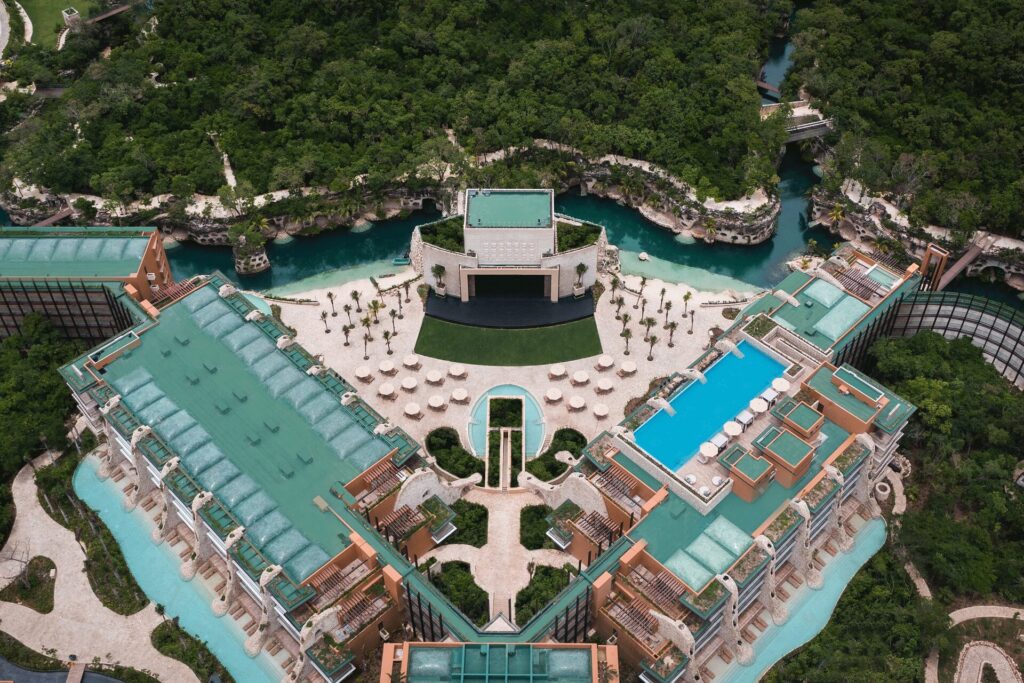
Grupo Xcaret has been an EarthCheck member for 17 years. Operating a portfolio of parks, hotels and experiences across the Riviera Maya, it is one of Mexico’s most recognised tourism operators and a long-standing leader in sustainable tourism practice.
In a region where access to local education and employment opportunities is key to long-term development, Xcaret has worked systematically to strengthen employment pathways that connect young talent with the local economy.
Of Xcaret’s 16,750 employees, the majority reside in key municipalities in Quintana Roo, the state that encompasses the Riviera Maya. Gen Z and Millennials make up the largest generational cohorts in the workforce, reflecting the organisation’s commitment to developing young talent from the communities where it operates.
Those employment pathways extend beyond direct hiring. Guests staying at Hotel Xcaret Arte find woven baskets at turndown, made by women in the local community using traditional techniques and filled with handmade candy produced by another nearby community.
Throughout the Xcaret Hotels portfolio, comprising 2,763 suites, guests encounter decorative elements crafted by Mexican artisans and sourced through responsible purchasing practices and fair payment criteria, with a direct vision for community development. Across Grupo Xcaret, 54,920 guest and visitor participations were recorded in cultural workshops and experiences during 2025, fostering appreciation for traditional knowledge, craftsmanship and Mexico’s living cultural heritage.
Xcaret’s community programs, delivered through the La Ceiba Chemuyil Community Center and in partnership with civil society organisations across the region, reached more than 70,000 people through education and sustainable development activities in 2025.
Launched in October 2024, the Kone’ex Xíimbal program provides families from Mayan communities in Quintana Roo with access to Xcaret’s parks as part of a social tourism initiative. As of the end of 2025, the program has reached a cumulative total of 725 beneficiaries from Mayan communities across the region.
Dr Montesalvo says Xcaret exemplifies what certified sustainability looks like in practice. “Xcaret’s approach demonstrates what becomes possible when a major operator commits fully to the communities it operates within,” she says. “The employment pipelines, the artisan supply chains, the local talent development work; all of it is built into how the business runs at every level.”
Iliana Rodríguez, Chief Sustainability and Institutional Dialogue Officer at Grupo Xcaret, says the partnership with EarthCheck has strengthened the organisation’s ability to better understand, monitor and communicate the progress and performance of its community and sustainability initiatives. “For us, sustainability has always been about preserving the places we call home and creating opportunities for our communities,” she says. “Working within the EarthCheck framework gives us the structure to measure that commitment, keep improving on it, and tell the world about it.”
A blueprint for the sector
Mexico now has the policy framework, the certification infrastructure and operator-level proof points to scale sustainable tourism in a way that is independently verified and internationally credible.
The renewed SECTUR–EarthCheck agreement provides the formal architecture, the Distintivo S provides the delivery mechanism, and operators like Xcaret show what genuine commitment looks like in practice.
For destination managers, tourism businesses and policymakers across Mexico, the pathway is clear: align with the national program, adopt the benchmarking framework, and measure and improve over time, in order to contribute to a tourism sector that is credible, competitive and built to last.
Stewart Moore, Founder and CEO of EarthCheck, says Mexico’s renewed commitment to the partnership marks a significant moment for the sector.
“For more than 30 years, EarthCheck has worked alongside governments and industry to deliver science-backed, measurable sustainability outcomes,” Mr Moore says.
“Mexico’s renewed commitment to this partnership, backed by one of the most comprehensive national tourism strategies in the country’s history, is a significant step forward for the entire sector.”
Join operators across Mexico and around the world in achieving independently verified sustainability performance. Learn more about becoming EarthCheck Certified.